.svg)



Tariff changes are forcing manufacturers to make fast, high-impact decisions about where products are manufactured. For many organizations, that has meant accelerating reshoring - the shift of production from offshore facilities to domestic plants.
From an executive perspective, the strategy is clear: reduce tariff exposure, protect margins, and increase supply chain resilience.
But the operational challenges in reshoring run deeper. The execution is where risk accumulates.
Line Transfers Are Much More than Equipment Moves
Relocating a production line from one region to another is a complex operational event. It involves far more than moving machines and restarting production. What’s being transferred is process knowledge, tacit expertise, quality standards, and lean discipline, often built up over years at the originating site.
As one manufacturing project manager put it:
“Inadequate product documentation, previous production problems, and communication challenges are the most common pitfalls of production transfer.” (innokas.eu)
Experts echo that the most difficult part to transfer is knowledge and experience and skills to solve malfunctions, disturbances, and interruptions. All of these are difficult to learn, and can't be simply put out in papers to facilitate the transfer of knowledge.
Brad Hulbert, Growth Advisory Director at Grant Thornton, adds:
“Almost every time I see a supply chain relocation go poorly, it’s because companies have disjointed communication.” (grantthornton.com)
As ComplianceQuest highlights in a recent blog:
“Reshoring often runs into unexpected engineering and compliance hurdles. Solving tariff and supplier issues is not always the hardest part—it’s ensuring local manufacturing partners can meet design tolerances, materials specifications, and quality standards, requiring engineering to redesign parts, update processes, and revalidate documentation in lockstep with supply chain teams.” (compliancequest.com)
This reinforces that relocating production is not just a logistical exercise. It’s a deeply collaborative, multi-disciplinary process. These insights underscore that production transfers are not just technical exercises. They require highly coordinated, cross-functional collaboration.
A Real-World Scenario: Moving a Line from APAC to the Midwest
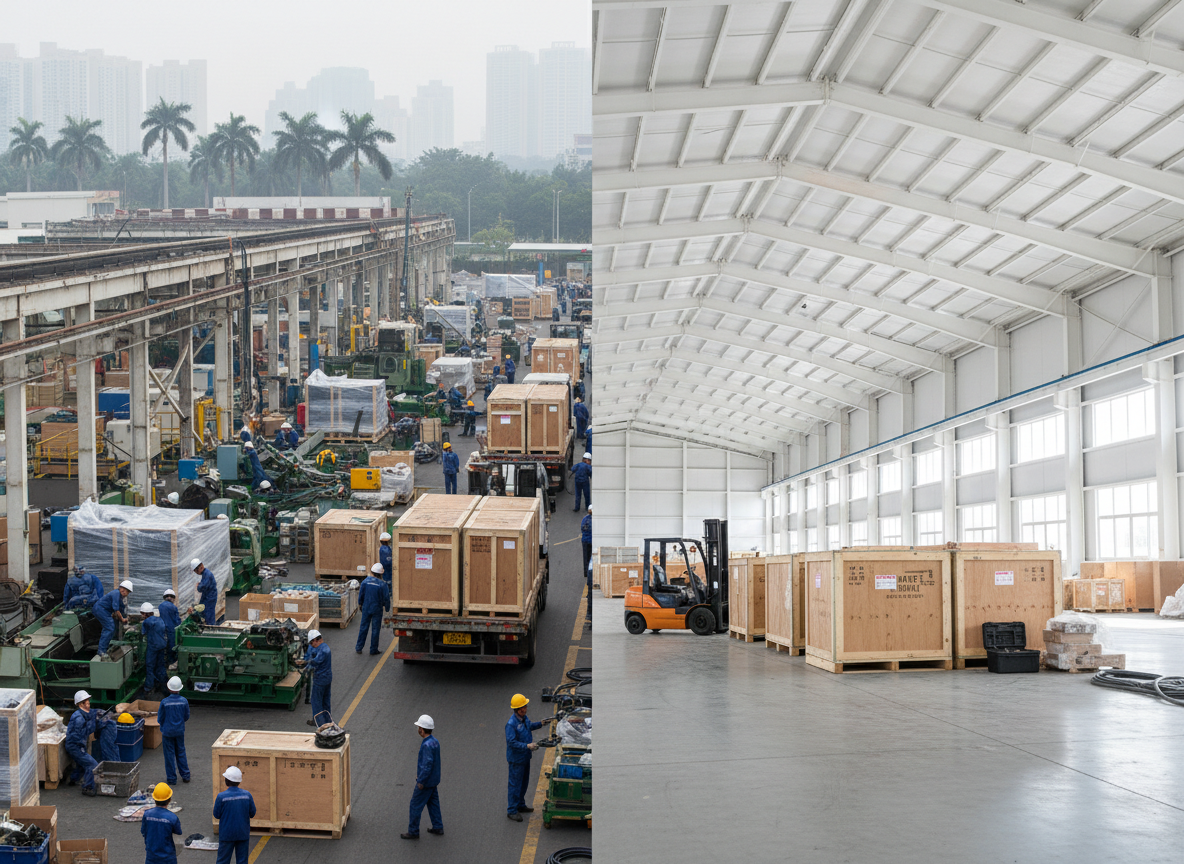
Consider a common situation: A manufacturer decides to move a high-volume assembly line from an APAC facility to a Midwest U.S. plant to mitigate tariff exposure. The timeline is aggressive. Customer demand can’t slip. Quality must be maintained from day one.
During the transfer:
- Equipment is installed at the Midwest plant, but minor layout differences affect material flow
- Maintenance teams encounter unexpected setup issues that require input from engineers familiar with the original line
- Lean leaders need to validate standard work, ergonomics, and takt time under real operating conditions
- Product engineers must confirm that early production runs meet quality and performance requirements
Traditionally, this would trigger multiple costly international trips, sometimes weeks at a time, for each functional group. Every delay compounds the cost. Every missed detail increases risk.
This is where many operations leaders are rethinking how collaboration happens during line transfers.
How Avatour makes Line Transfers efficient
Avatour enables teams to collaborate on the production floor both in real time and/or asynchronously, without being physically present. Using live or recorded 360° walkthroughs, remote experts can see the same line, the same equipment, and the same issues as on-site teams.
Benefits include:
- Immersive walkthroughs, live or recorded, for maintenance, process, and product engineers
- Efficient collaboration across time zones without travel delays- both real-time and asynchronous.
- Knowledge retention through captured walkthroughs and best practices for future line transfers, using AI summaries, captured annotations, and making communication simple
- Lean process validation for CI teams observing workflows, safety, and efficiency remotely
- Cost reduction by eliminating multiple international trips
In the APAC → Midwest scenario, Avatour allows engineers, lean managers, and operators to align instantly on problems and solutions, reducing ramp-up time and mitigating risk.
Turning Tariff Pressure into an Operational Advantage
Tariff-driven localization is forcing manufacturers to execute complex changes at scale. The winners will be those who modernize not just where they produce, but how their teams collaborate during transition.
Avatour gives operations leaders a way to maintain control, visibility, and alignment across regions, without the friction and cost of constant travel.
For operations leaders, the ability to collaborate digitally across production sites offers a strategic advantage:
- Accelerated line transfers without excessive travel costs
- Reduced risk of operational disruptions
- Consistent quality and compliance across facilities
- Real-time visibility into workflows for faster decision-making
In a world where tariffs and localization are reshaping manufacturing, the winners will be those who modernize how teams collaborate, not just where they produce.
Manufacturing may be local, but collaboration no longer has to be.