.svg)



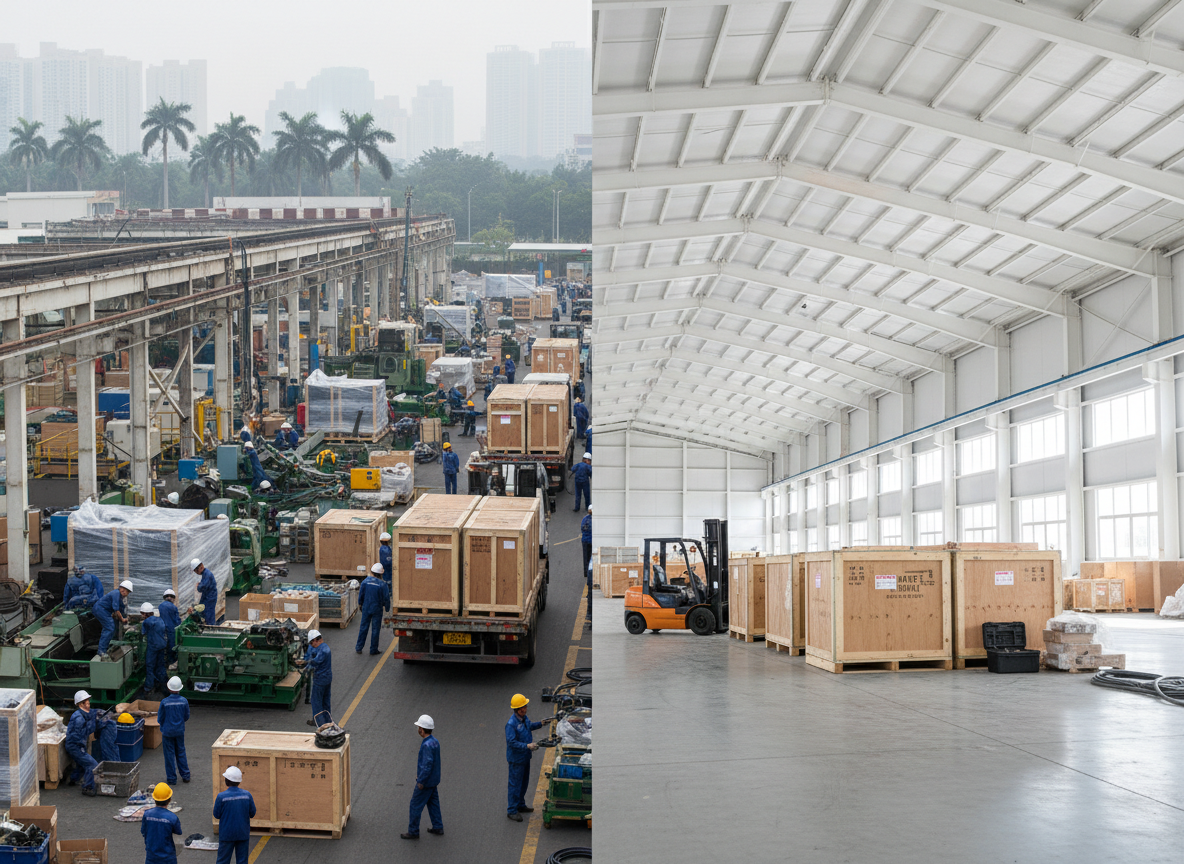
Manufacturing Line Transfers: Why 360° Collaboration is the New Standard
Moving production from one facility to another is one of the most demanding operational challenges in manufacturing today. It demands deep visibility into both the source and destination sites — and yet, for most teams involved, actually being there remains frustratingly out of reach. This is where 360° collaboration technology steps in.
What Are Manufacturing Line Transfers?
A manufacturing line transfer is the process of relocating a production line — or an entire product's manufacturing process — from one facility to another. The goal is to replicate, or improve upon, the output, quality, and efficiency of the original line at its new location.
This is far from simply packing up equipment and shipping it out. It requires a detailed understanding of every stage of the production process, from raw material handling through to final assembly and quality checks. Both teams — at the old site and the new — must work in close coordination to ensure nothing is lost in translation.
Why Are Line Transfers on the Rise?
Several converging forces are driving more manufacturers to relocate production lines:
- Geopolitical risk — Tariffs, export controls, and shifting trade policies are prompting companies to reassess where they manufacture.
- Supply chain resilience — The COVID-19 pandemic exposed the danger of relying on a single manufacturing hub. The China Plus One strategy has gained significant traction as businesses seek to diversify.
- Cost pressure — Rising labour and operational costs in traditional manufacturing regions are making transfers to more competitive locations essential to profitability.
As Yossi Sheffi, Professor of Transportation and Logistics at MIT, puts it: "Products can be easily copied. But a supply chain can provide a true competitive advantage." In that light, where and how you manufacture has never mattered more.
The Core Challenge: You Need to Be There
Here's where line transfers start to resemble a familiar problem in continuous improvement: you need to see the work where it happens.
In Lean methodology, this is the principle of the Gemba — the "real place" where value is created. A Gemba Walk means going to that place, observing operations firsthand, and identifying opportunities for improvement. The logic is simple: decisions made away from the shop floor are inevitably less informed.
A line transfer makes this principle especially critical — because there are two Gembas involved:
- The source site — You need to understand exactly how the current line works: its sequencing, spatial layout, and the informal workarounds that have developed over time.
- The destination site — You need to assess its layout, equipment, and workflows to determine how well they will accommodate the incoming line.
Ideally, engineers and project managers would visit both sites regularly. In practice, this is rarely feasible. Line transfers are often cross-border — sometimes intercontinental. Travel is expensive, time-consuming, and disruptive.
As W. Edwards Deming observed: "Eighty-five percent of the reasons for failure are deficiencies in the systems and process rather than the employee." Without adequate visibility into both sites, process failures become almost inevitable.
Why Video Calls Aren't Enough
When on-site visits aren't possible, the natural fallback is a video call. But standard video conferencing falls well short of what a line transfer demands.
A typical video call offers a fixed, two-dimensional view — limited to whatever the person on site chooses to show. You can't look around a corner, assess spatial relationships between workstations, or get a true sense of scale and flow. Critical details are easily missed, and the further apart the two sites are, the harder it becomes to course-correct when things go wrong.
The Solution: 360° Collaboration with Avatour
Avatour is a 360° video collaboration platform that gives remote teams genuine visibility of physical sites — without the need to travel. It captures a full panoramic view of any environment in real time, meaning every participant can independently look around and observe the site as though they were standing there in person.
Live walkthroughs
Teams at the source site can stream a live 360° walkthrough of the production line. Engineers and project managers at the receiving site — or anywhere in the world — can study the layout, observe the process flow, and ask questions in real time. Each participant controls their own view independently, so multiple stakeholders can focus on different aspects of the line at once.
Asynchronous collaboration
Avatour doesn't stop at live sessions. Teams can record 360° walkthroughs and share them for later review. Participants can add annotations and notes directly within the 360° video, flagging areas of interest or highlighting details that need attention at the new site. This makes it an invaluable tool for documentation and knowledge transfer — not just during the project, but well beyond it.
Whether it's assessing the source line, evaluating the receiving site, or coordinating the transfer itself, Avatour brings both Gembas into the room for everyone involved.
Get Started
Manufacturing line transfers are only going to become more common as global supply chains continue to evolve. The teams that navigate them most successfully will be the ones with the best visibility — not just of their own sites, but of every site involved.
If you'd like to see how Avatour can support your next line transfer project, schedule a demo or get in touch with us to learn more.